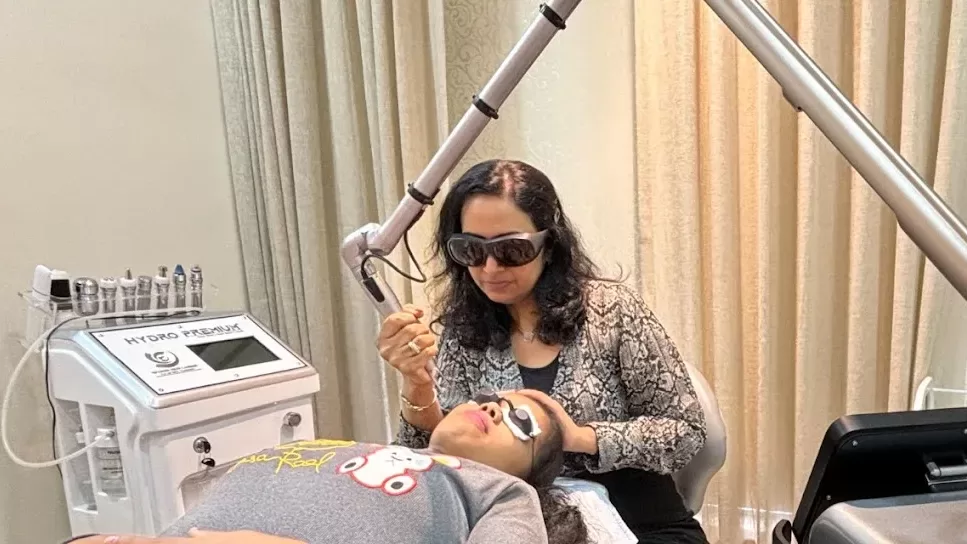
Acne scar treatment on face: why HIFU and MNRF are the most effective solutions today
The acne cleared months ago. You followed the treatment, the breakouts stopped, and you moved on. But the face in the mirror has not quite moved on with you. Where the deep pimples used to be, there are now small depressions in the skin, some narrow and sharp, some broader and box-shaped, some that create a wave-like unevenness across the cheeks that catches the light in a way that makes the skin look rough and pitted even when it is otherwise clear. Sometimes there are dark marks alongside them, sometimes not. But the texture is there, and it is not going away on its own.
Acne scars on the face are one of the most common skin concerns in India and one of the most undertreated, partly because people assume they are permanent and partly because the available treatment options are poorly understood. The serums have not worked. The home remedies have not worked. And the prospect of something clinical feels either intimidating or unclear. But the treatment landscape for acne scars on the face has changed significantly in recent years, and the two most effective non-surgical options available today, HIFU and Vivace MNRF, work at the precise depth where acne scars exist and produce results that no topical product can replicate.
This blog explains what acne scars on the face actually are at a structural level, why they do not respond to topical treatments, how HIFU and MNRF each work to address them from inside the skin, which scar types each treatment is best suited for, and what to expect from a treatment programme at Dr. Reshma Ahuja’s clinic in Powai.
Three Reasons Acne Scars on the Face Do Not Respond to Surface Treatments

Acne Scars Are a Structural Deficit Inside the Skin, Not on Its Surface
Atrophic acne scars form when the inflammation of a deep pimple destroys collagen in the dermis, the deep structural layer of the skin. The depression visible on the surface is a reflection of missing volume below it. No serum or cream applied to the top of the skin can rebuild the dermal collagen framework beneath it because topicals cannot penetrate to the dermis in meaningful concentrations. The problem is below the reach of everything applied above.
Dark Marks Are Not the Scars Themselves and Need a Different Approach
Many people use the terms scar and dark mark interchangeably, but they are different things needing different treatment. Post-inflammatory hyperpigmentation (PIH) is the flat discolouration the skin deposits in response to inflammation, very common in Indian skin and responsive to topical brightening agents and sunscreen over time. The actual scar beneath it, the textural depression or irregularity, is not. Treating only the pigment leaves the structural scar entirely unaddressed.
Laser Treatments Carry Higher Risk on Indian Skin Tones
Ablative laser resurfacing works well for acne scars in lighter skin tones but carries a significant risk of post-procedure hyperpigmentation in medium to darker Fitzpatrick skin types that represent the majority of Indian patients. HIFU and MNRF bypass this risk because neither relies on surface heat or UV interaction. They work through the skin to the dermal layer without the chromophore-dependent mechanism that makes certain lasers unsuitable for darker skin tones, which is precisely why they have become the preferred approach for Indian patients.
The Types of Acne Scars on the Face and Why They Matter for Treatment
Not all acne scars on the face are the same, and the type determines how each treatment is calibrated and which approach achieves the best outcome. A dermatologist examines the scar morphology before recommending any treatment because the same procedure applied without this distinction produces uneven results.
Vivace MNRF: How It Works and Why It Is Highly Effective for Acne Scars
Vivace MNRF, which stands for Microneedling Radiofrequency, is the gold standard non-surgical treatment for acne scars on the face in Dr. Reshma Ahuja’s clinic. It is the treatment that directly addresses the deficit where acne scars live, inside the dermis, using two simultaneous mechanisms that no single topical or surface treatment can replicate.
The Vivace device uses an array of ultra-fine insulated needles that are inserted into the skin to a precisely calibrated depth, reaching the dermis directly. At the needle tips, radiofrequency energy is released as controlled thermal energy into the dermal tissue. This heat does two things simultaneously: it stimulates the fibroblast cells in the dermis to produce new collagen in the area of the scar, and it causes immediate contraction of existing collagen fibres, which provides a visible tightening and smoothing effect even in early sessions. Because the needles are insulated along their length and only release energy at the tips, the skin surface itself is protected throughout the procedure, which is why there is virtually no downtime and no surface damage that would risk hyperpigmentation in Indian skin.
- The procedure takes approximately thirty to forty-five minutes. A numbing cream is applied beforehand and most patients experience minimal discomfort. The Vivace device also delivers LED light therapy immediately after the radiofrequency treatment, which reduces post-procedure redness and supports the skin’s immediate healing response.
- Downtime is minimal. Mild redness and slight swelling for twenty-four to forty-eight hours is the typical response. Most patients return to work or daily activity the same day or the day after. There is no peeling, no raw skin surface, and no extended recovery period that requires staying out of the sun for weeks.
- Results develop gradually as collagen remodelling takes place over the weeks following each session. Most patients see visible improvement in scar depth, skin texture, and pore size progressively across three to six sessions, with each session building on the collagen produced in the previous one. The improvement continues for three to six months after the final session as the new collagen matures and organises.
- Vivace MNRF is safe for all skin types including Indian skin across the medium to darker Fitzpatrick range. Because the radiofrequency energy is colour-blind and does not interact with melanin the way laser energy does, there is no risk of the laser-related pigmentation that makes ablative resurfacing a concern for Indian patients. Every session at Dr. Ahuja’s clinic is performed by Dr. Ahuja herself, a Gold Medalist MD Dermatologist with 26 years of experience, not delegated to a therapist or technician.
HIFU: How It Works and Where It Fits in the Acne Scar Treatment Plan
HIFU, or High Intensity Focused Ultrasound, delivers precisely focused ultrasound energy to targeted depths within the skin and underlying tissue without breaking the skin surface at all. The focused energy creates controlled thermal coagulation points at the precise depth where the tissue is targeted, stimulating the body’s wound healing response and triggering new collagen production at those focal points.
In the context of acne scar treatment on the face, HIFU plays a complementary and sometimes primary role depending on the scar type and the patient’s overall skin concerns. Its key characteristics in this context are as follows.
- HIFU is entirely non-invasive. No needles penetrate the skin. The ultrasound energy passes through the skin surface without damaging it and converges at the precise target depth below. For patients who are hesitant about any needle-based procedure, HIFU offers a genuinely needle-free route to dermal collagen stimulation that still reaches the tissue layer where acne scars exist.
- HIFU can be calibrated to target multiple tissue depths in a single session, from the superficial dermis to the deeper SMAS layer below the dermis. For patients whose acne scarring is accompanied by skin laxity, loss of facial firmness, or early jowling as an additional concern, HIFU addresses the scar-related collagen deficit and the laxity simultaneously. This makes it particularly useful for patients in their late thirties and forties who are managing both acne scar texture and age-related skin changes at the same time.
- HIFU has essentially no downtime. Mild redness and a sensation of warmth in the treated area for a few hours after the procedure is the typical response. Most patients resume their full routine the same day. Sessions take between thirty and ninety minutes depending on the area being treated and the number of treatment lines required in the protocol.
- Results from HIFU for scar-related collagen stimulation develop over two to three months as new collagen is produced and remodelled at the treated depth. For skin tightening and laxity concerns, the improvement timeline extends to three to six months. A single well-performed session produces meaningful results, and the protocol frequency is typically once every six to twelve months depending on the patient’s specific concerns and goals.
HIFU vs MNRF for Acne Scars: Which One Is Right for Your Skin
The question of which treatment to choose is not always a binary one. In many cases, the most effective treatment plan for acne scars on the face combines both modalities, with MNRF as the primary scar treatment and HIFU addressing overall skin quality, firmness, and the deeper tissue support that makes the scar improvements more visible and longer-lasting. The specific recommendation depends on the scar types present, their depth and distribution, the patient’s age and skin laxity, and their tolerance for needles versus their preference for a fully non-invasive approach.
Summary
Acne scars on the face are not permanent in the way many people believe they are. They are a structural problem with structural solutions, and the gap between what a topical product can do and what HIFU and MNRF can do is not a small one. It is the difference between applying something to the surface of a deficit and delivering energy directly to the tissue where the deficit lives. If your acne scars have not responded to anything you have tried, it is not because your skin cannot be improved. It is because the treatments you have tried have not reached the depth where the improvement needs to happen. A consultation with Dr. Reshma Ahuja at the Skin and Hair Clinic, Hiranandani Gardens, Powai, begins with a direct examination of your scar types, a mapping of which areas would benefit most from which treatment, and a protocol built specifically for your skin rather than a generic plan. Your scars have a specific architecture. The treatment plan should match it.