
Warts and Moles: When Should You Get Them Checked or Removed?
Almost everyone has a mole or two they have never thought twice about, and most people have dealt with at least one wart at some point. Both are usually harmless. The trouble is, “usually” is not “always,” and most people have no clear idea of where that line actually sits.
Some people search for mole removal treatment in Powai purely for cosmetic reasons, a mole in an awkward spot, or a wart that keeps catching on clothing. Others are quietly worried about something that has started to change and are not sure if that worry is warranted. Both are legitimate reasons to see a dermatologist, but they call for very different urgency.
Here is how to tell which category yours falls into, and what actually happens when you get it removed.
Moles and Warts, at a Glance

What a Mole Is
A cluster of pigment-producing cells. Not contagious, and most people carry several without any issue at all.
What a Wart Is
A rough skin growth caused by HPV. Contagious through direct contact, and can spread to other parts of your own skin too.
When It Stops Being Cosmetic
Any change in size, shape, or color, or a wart that bleeds, spreads, or won’t respond to treatment, needs a dermatologist’s opinion.
The ABCDE Rule: How Dermatologists Actually Check a Mole
The American Academy of Dermatology’s ABCDE rule is the standard framework for spotting a mole that needs a closer look. Each letter checks a different visual clue that can point toward melanoma, the most serious form of skin cancer.
- Asymmetry, one half of the mole doesn’t match the other
- Border, edges that are irregular, scalloped, or poorly defined
- Color, several shades of brown or black in one spot, or patches of white, red, or blue
- Diameter, larger than about 6mm, roughly the size of a pencil eraser
- Evolving, any change in size, shape, color, or texture over time
Beyond ABCDE: Signs Worth Acting On Regardless
A 2015 review in the Journal of the American Academy of Dermatology pointed out an important limitation, ABCDE is a strong starting point, but some early melanomas simply don’t tick every box yet. That is why dermatologists also watch for what is often called the “ugly duckling” sign, a mole that looks distinctly different from the others on your body, even if it doesn’t technically meet the ABCDE criteria.
A new mole appearing after the age of 30, a mole that bleeds without being scratched or bumped, or one that itches persistently, are also reasons to get it looked at, even without a textbook ABCDE change.
When a Wart Needs a Dermatologist, Not a Home Remedy
Many warts do settle on their own, especially in children, and mild over-the-counter salicylic acid treatments handle a good number of the rest. A dermatologist visit becomes worthwhile when a wart is painful, spreading despite treatment, bleeding often, sitting on the face or a sensitive area, or simply not responding after several weeks of consistent home care.
How Mole and Wart Removal Actually Works
In a clinical setting, this is a short, local procedure done under local anesthesia, not a major surgery. The method depends on what is being removed and why.
- Shave excision, a mole is gently shaved level with the surrounding skin
- Excision with stitches, used for a mole that needs to be removed more fully, often when there’s any concern worth ruling out
- Cryotherapy, freezing warts off with liquid nitrogen
- Electrocautery, burning off a growth with a fine electric current
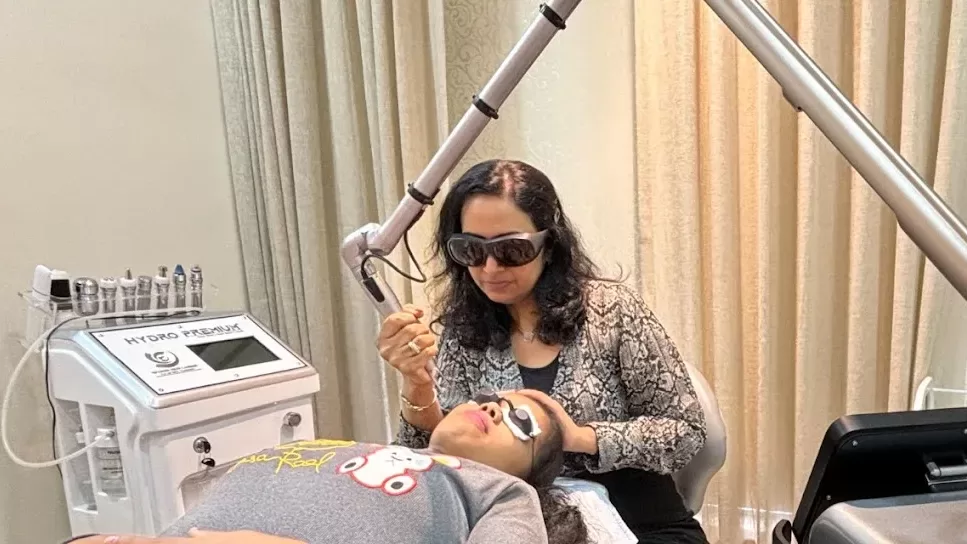
- Laser removal, precise treatment for select moles and stubborn warts
Any mole that is removed for medical reasons, rather than purely cosmetic ones, should be sent for lab analysis, or a biopsy, to confirm exactly what it was. This is standard practice, not a sign that something is necessarily wrong.
Cosmetic Removal Is a Valid Reason Too
Not every removal is about ruling out a health concern. A mole that catches on jewelry or a razor, sits somewhere visible you’d simply rather it didn’t, or a wart that’s more of an annoyance than a symptom of anything serious, are perfectly valid reasons to have it removed. The point is doing it through a dermatologist rather than an at-home method, so it heals cleanly and without unnecessary scarring.
Why At-Home Removal Is Riskier Than It Looks
Tying off a mole with thread, using unregulated wart removal creams on a spot that hasn’t actually been diagnosed, or attempting a DIY removal at home, all carry real risks, excessive bleeding, infection, and permanent scarring among them. There’s a second, less obvious risk too, if what you’re removing turns out to be something that needed medical attention, doing it yourself removes the evidence a dermatologist would otherwise be able to examine.
Getting a Mole or Wart Checked in Powai
Whether you’re looking into mole removal treatment in Powai for peace of mind or purely for how it looks, the first step is the same, a proper examination rather than a guess. A dermatologist near you in Powai can look at exactly what you’re dealing with and tell you whether it needs monitoring, a biopsy, or a straightforward removal. If you’d rather start with a general skin check, our skin specialist in Powai page has more on what a full consultation covers.
Summary
Most moles and warts genuinely are nothing to worry about, but the only way to know for sure is to have someone qualified actually look at it. If yours has been on your mind, that alone is reason enough to get it checked, rather than to keep wondering.

Leave a Reply
You must be logged in to post a comment.