
Ice-Pick, Boxcar, or Rolling? How to Tell Your Acne Scar Type Apart
Your acne may be long gone, but the marks it left behind are still staring back at you every time you check the mirror under bright light. Most people call this “acne scarring” as if it is one single thing. It is not. Dermatologists actually recognize a few very different types of acne scars, and mixing them up is the easiest way to end up frustrated with a treatment that was never going to work on your skin in the first place.
The three most common depressed acne scars are ice-pick, boxcar, and rolling scars, and most people have more than one type at once. Each one looks and behaves differently, and each one responds to a different kind of treatment. A plan built for boxcar scars can underperform badly on ice-pick scars, and a plan that ignores rolling scars will only fix the surface while the real problem stays tucked underneath.
If you have been searching for the different types of acne scars, trying to work out which one is looking back at you in the mirror, this guide breaks each type down, in plain language, before you decide on a treatment.
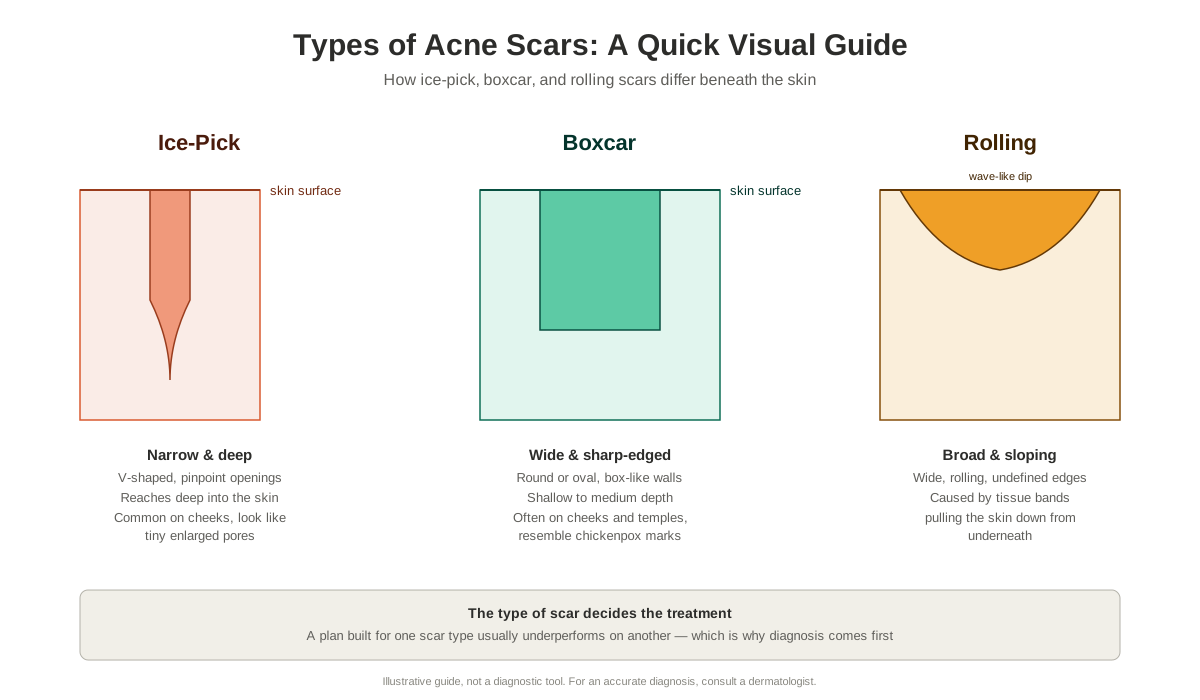
The Three Types of Acne Scars, at a Glance

Ice-Pick Scars
Narrow, deep pits that look like a tiny puncture. They form when the skin makes too little collagen while healing from a deep, inflamed breakout.
Boxcar Scars
Round or oval depressions with sharp, defined edges, almost like a box cut into the skin. You can read more about how these depressed scars are identified on the American Academy of Dermatology’s website.
Rolling Scars
Broad, shallow dips with sloping edges, giving the skin a wavy texture. They form when fibrous bands pull the skin down from underneath.
Why Knowing Your Acne Scar Type Actually Matters
This is not cosmetic trivia. The type of acne scar you have decides whether you need subcision, microneedling, a resurfacing laser, a punch technique, or a combination of these, and in what order they should be done.
A rolling scar that is caused by a tethered band under the skin will barely respond to surface-level treatments until that band is released. An ice-pick scar, being so narrow and deep, often needs a completely different approach than a wide, shallow boxcar scar sitting right next to it. Our acne scar treatment plans start with this exact classification step, because guessing wastes both time and money.
How Dermatologists Tell Types of Acne Scars Apart
A proper diagnosis usually starts with angled lighting. Shining light across the skin at a low angle throws shadows into every dip, making the true depth and edges of each scar much easier to see than under flat, overhead light.
The next check is often the skin stretch test. When the skin around a rolling scar is gently stretched, the dip tends to flatten out or disappear, because the problem is a band pulling from below rather than a hole in the skin itself. Ice-pick and boxcar scars, on the other hand, stay put when the skin is stretched, since their walls are structurally fixed.
Ice-Pick Scars: The Deep, Narrow Punctures
Ice-pick scars usually form after deep, inflamed, or cystic acne on the cheeks or temples. The opening on the surface can be as small as an enlarged pore, but the scar tunnels straight down into the deeper layers of the skin, which is what makes it so stubborn.
Because it goes so deep and stays so narrow, surface resurfacing alone rarely reaches the base of an ice-pick scar. These usually respond best to targeted techniques that work at the depth of the scar itself, often combined over more than one session.
- Opening is narrower than a couple of millimeters
- Often mistaken for a large, permanently open pore
- Considered the most difficult acne scar type to treat fully
Boxcar Scars: The Broad, Sharp-Edged Craters
Boxcar scars get their name from their shape, a round or oval depression with sharp, vertical walls, similar to a box cut into the skin. They are wider than ice-pick scars and tend to sit at a shallow to medium depth, most often on the cheeks and jawline.
Because they sit closer to the surface, boxcar scars usually respond well to a mix of resurfacing and volume-restoring treatments, such as MNRF microneedling, which encourages the skin to rebuild its own collagen and gradually soften those sharp edges.
- Round or oval shape with well-defined borders
- Often described as looking similar to chickenpox marks
- Does not flatten when the surrounding skin is stretched
Rolling Scars: The Wavy, Shadowed Dips
Rolling scars are broad and shallow, with soft, sloping edges that blend into the surrounding skin. Unlike the other two types, the surface itself is not really damaged, instead, fibrous bands form underneath and pull the skin down from below, creating a wave-like, undulating texture.
This is exactly why surface treatments alone rarely fix rolling scars. The underlying band usually needs to be released first, subcision, before treatments like microneedling or PRP can help rebuild smoother, firmer skin on top.
- Widest and shallowest of the three types
- Skin looks more textured than pitted, especially in bright light
- Tends to flatten or soften when the skin is gently stretched
Quick Differences: Ice-Pick vs Boxcar vs Rolling
- Ice-pick: narrowest opening, goes the deepest into the skin
- Boxcar: wide, box-shaped, with sharp edges that do not fade
- Rolling: widest and softest, edges flatten when skin is stretched
Why Mumbai Skin Needs Extra Care With Acne Scarring
Indian skin tends to pigment more easily than fairer skin types, and Mumbai’s heat and humidity make people more likely to pick or squeeze breakouts, which only pushes inflammation deeper and increases the chance of true scarring. Aggressive, unsupervised home treatments can also leave dark marks behind, on top of the texture change.
This is why treatments for pigmentation-prone skin, like a properly calibrated chemical peel, are usually paired with scar-specific procedures rather than used on their own.
Can Skincare Alone Fix These Scars?
A good skincare routine, with ingredients like vitamin C and gentle retinoids, can genuinely fade the flat, discolored marks that acne leaves behind. But once the scar has changed the texture of the skin, as ice-pick, boxcar, and rolling scars do, skincare on its own has limits. That kind of structural change needs a procedure that rebuilds collagen or releases what is pulling the skin down.
When to See a Dermatologist
If your acne scars are affecting your confidence or you are simply not sure which type you have, a dermatologist can examine your skin under proper lighting, confirm the type or mix of types you are dealing with, and build a plan around it, instead of you guessing your way through products that were never made for your scar type.
Summary
Once you know which of the types of acne scars you are actually dealing with, ice-pick, boxcar, rolling, or a mix of all three, choosing the right acne scar treatment becomes a lot less like guesswork and a lot more like a plan.


Leave a Reply
You must be logged in to post a comment.