Are stretch marks treatable or is that just what brands want you to believe
You know them immediately when you see them on yourself. Those lines. On your stomach after pregnancy, across your hips and thighs after a growth spurt in your teens, on your arms or chest after a period of rapid weight change. At first they are pink or purple or red, slightly raised, a little sensitive to touch. Then they fade into silver or white. And there they stay, permanently. You have tried the cocoa butter. You have tried the oils. You have tried the expensive stretch mark creams with the confident before-and-after photos on the packaging. And either nothing changed or the change was so minimal you had to hold the photos six inches from your face to see it.
So the real question is whether stretch marks can actually be removed or significantly reduced, and if so, how and by what. Not by what a cream company says. By what the science and clinical evidence actually show. This blog gives you the honest answer that most brands do not want you to find because the honest answer requires clinical treatment, not another tube of something from a pharmacy shelf.
This blog covers what stretch marks actually are at a biological level, why creams almost never work, what the difference between red and white stretch marks means for treatment, which clinical treatments have real evidence, and what a dermatologist would actually recommend based on your specific stretch marks. Read this before spending another rupee on a product that was never going to do what it promised.
Three Things That Determine Whether Your Stretch Marks Can Be Treated

Their Colour Tells You How Treatable They Currently Are
Red or purple stretch marks are fresh. The underlying tissue is still actively changing, blood vessels are still present, and the scar is still responsive to treatment. These are your window of opportunity. White or silver stretch marks are mature scars where the tissue has fully settled. They are significantly harder to treat and respond to a more limited range of interventions.
Complete Removal Is Not Possible but Dramatic Improvement Is
No treatment currently available can completely erase stretch marks. They are scars in the deep layer of skin. What clinical treatments can genuinely achieve is a significant reduction in their visibility, improved texture, better colour matching with the surrounding skin, and in some cases a reduction so dramatic that the marks become difficult to see. Significant improvement is a realistic goal. Complete erasure is not.
Creams Cannot Reach Where Stretch Marks Actually Form
Stretch marks form in the dermis, which is the deep middle layer of skin. Topical creams and oils stay in the epidermis, which is the surface layer. No matter how expensive or how well-marketed the cream, it cannot penetrate deeply enough to reach the torn collagen and elastin fibres where the actual scar exists. This is the fundamental reason that creams do not meaningfully treat stretch marks and never will.
What Stretch Marks Actually Are and Why They Are So Hard to Treat
The medical name for stretch marks is striae distensae. They form in the dermis, which is the deep middle layer of skin directly below the visible surface. The dermis is where your skin’s structural framework lives. It contains a dense network of collagen fibres, which provide firmness and support, and elastin fibres, which allow the skin to stretch and snap back. When the skin is stretched faster than these fibres can accommodate, they literally tear. The tears run parallel to the direction of the stretch, which is why stretch marks appear as lines rather than random patches.
This is why stretch marks are scars, not surface marks. Just as a scar on the face from a cut represents a wound that healed in the dermis, stretch marks represent tears in the dermis that healed into scar tissue. And exactly as with any other scar, the healed tissue is structurally different from the surrounding skin. It will never be identical to unaffected skin regardless of what you apply to the surface above it.
Stretch marks can develop during pregnancy, puberty, rapid weight gain or loss, bodybuilding, and in people taking long-term corticosteroid medications. They are also influenced by genetics. If your mother or grandmother had significant stretch marks, you have a higher likelihood of developing them under similar conditions. Some people with genuinely good skin elasticity and no family history develop minimal stretch marks through the same pregnancy that leaves another person with extensive ones. This is not a reflection of skincare or self-care. It is biology.
Red Stretch Marks Versus White Stretch Marks: Why the Colour Changes Everything
The colour of your stretch marks is the single most important factor in determining how well they will respond to treatment. Understanding this is worth more than any product recommendation.
The most common scenario dermatologists see is someone who spent a year applying cocoa butter to red stretch marks, during which time the stretch marks naturally faded to white on their own timeline, and then attributed the colour change to the cream. The cream did nothing. Time did everything. By the time they arrive at the clinic, the white marks are significantly harder to treat than the red ones they originally had.
Why Creams and Oils Simply Do Not Work on Stretch Marks
The stretch mark cream industry in India is enormous. Cocoa butter, shea butter, vitamin E oil, almond oil, bio-oil, collagen creams, elastin creams, and a long list of herbal formulations are purchased by millions of pregnant women, new mothers, and teenagers every year. Most of them provide no meaningful improvement to the stretch marks themselves for one simple and inescapable reason.
Stretch marks form in the dermis. Topical products applied to the skin surface penetrate only into the epidermis, which is the uppermost layer of skin. The dermis sits below the epidermis and is separated from it by a basement membrane. A moisturiser, oil, or cream cannot cross this barrier in concentrations meaningful enough to reach and repair torn collagen and elastin. Applying collagen cream to the skin surface does not deliver collagen to the dermis. Applying vitamin E oil to the surface does not rebuild the internal scar structure. The promise and the reality are separated by a layer of skin that topical products cannot meaningfully cross.
The one topical category that does have limited but real evidence for early stretch marks is prescription topical retinoids, which are vitamin A derivatives. Retinoids work by stimulating collagen production in the dermis and increasing skin cell turnover. They have been shown in clinical studies to meaningfully reduce the depth and appearance of striae rubrae, the red stage, when applied consistently over several months. However, they require a prescription, cannot be used during pregnancy or breastfeeding, and need to be applied with sun protection since they increase skin sensitivity. Over-the-counter retinol products sold in pharmacies and beauty stores are at concentrations too low to produce the same effect.
The Clinical Treatments That Actually Make a Visible Difference
The treatments with actual clinical evidence for stretch marks are those that can reach the dermis directly or stimulate the dermis from below the skin surface. None of these come in a cream. All of them require a dermatologist.
- Microneedling, also called collagen induction therapy, uses a device with very fine needles to create thousands of controlled micro-injuries in the dermis at the depth where the stretch mark scar sits. The body responds to these controlled injuries by producing new collagen and elastin to repair them. Over multiple sessions, this new collagen fills in the depression of the stretch mark, improves texture, and makes the marks less visible. Microneedling has some of the strongest evidence for both red and white stretch marks of any non-laser treatment. Results are progressive across four to six sessions spaced four weeks apart.
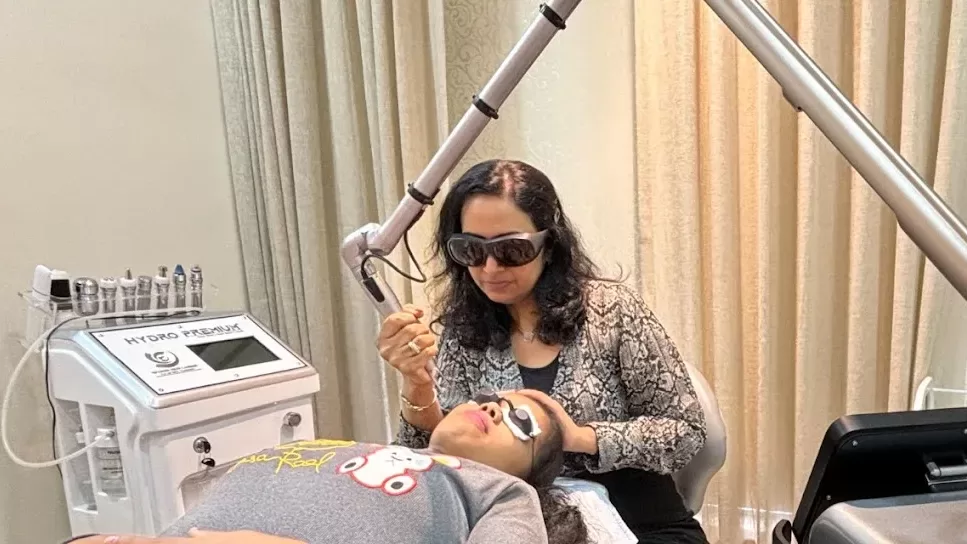
- Laser treatments are among the most effective options for stretch marks, with different laser types suited to different stages. Pulsed dye laser targets the red colour and active blood vessels in striae rubrae and significantly reduces the redness while stimulating collagen production. Fractional ablative and non-ablative lasers work on both red and white stretch marks by creating targeted heat zones in the dermis that stimulate new collagen formation and resurface the stretch mark’s texture. Multiple sessions are required and results are cumulative. For Indian skin tones, the specific laser type and settings matter enormously to avoid post-procedure pigmentation changes and a dermatologist with experience in treating darker skin should be consulted.
- Radiofrequency treatments deliver controlled heat energy into the dermis to stimulate collagen and tighten the skin around stretch marks. They work particularly well for improving skin texture and reducing the indented, slightly wrinkled appearance that many white stretch marks develop over time. Radiofrequency is often combined with microneedling for enhanced results, a combination called RF microneedling or MNRF, which delivers energy directly into the dermis via the microneedles for a combined collagen stimulation effect.
- Chemical peels using trichloroacetic acid or glycolic acid at clinical concentrations cause controlled exfoliation and collagen stimulation in the upper dermis. They are most useful for red stretch marks and for improving texture, and are often used as part of a combination protocol alongside microneedling rather than as a standalone treatment. They are more accessible and affordable than laser for many patients and produce meaningful improvement when done in a series.
Setting Realistic Expectations: What Treatment Can and Cannot Achieve
Honesty about what is achievable protects people from spending money on treatments with unrealistic expectations and then feeling disappointed by results that were actually good. Here is a clear-eyed picture of what clinical treatment can genuinely offer.
- For red stretch marks treated early with prescription retinoids, microneedling, or laser, a 50 to 70 percent improvement in visibility, texture, and colour is a realistic outcome with a full course of treatment. In some cases the improvement is dramatic enough that the marks become very difficult to see from a standing distance.
- For white or silver stretch marks, a 30 to 50 percent improvement in texture and a moderate improvement in colour matching is what most people can realistically achieve with multiple clinical sessions. The stretch marks will not disappear but they can become significantly less obvious, feel smoother to the touch, and colour-match better with the surrounding skin.
- Multiple sessions are always required. There is no single treatment that produces significant results in one visit. Microneedling and laser protocols for stretch marks are planned across four to eight sessions spaced three to four weeks apart. Results build progressively over the treatment course and continue improving for up to six months after the final session as the collagen remodels.
- No treatment reverses a stretch mark to unaffected skin. The scar structure in the dermis is permanently altered. What treatment achieves is making the marks less visible, less textured, and better matched to surrounding skin. That is a genuinely meaningful and worthwhile outcome for most people even if it is not the complete removal that packaging often implies.
What You Can Do at Home That Actually Helps
While at-home products cannot remove stretch marks, some habits genuinely support the skin’s overall health and can improve how stretch marks look over time, especially when used alongside clinical treatment.
- Moisturise the area consistently. Moisturiser does not treat the scar but it improves the surface appearance of the skin above it, keeping it smooth, hydrated, and less likely to look dry and crinkled. Well- moisturised skin around stretch marks also tends to reflect light more evenly, making the marks less visually prominent. A thick moisturiser or body butter applied daily to the stretch mark area genuinely improves how the skin looks even if it does nothing to the scar itself.
- Protect stretch marks from sun exposure. The skin within a stretch mark has reduced melanin compared to the surrounding skin. Without sun protection, the surrounding skin tans and the stretch mark stays pale, making the contrast more visible. With consistent sun protection on exposed stretch marks, the colour contrast between the mark and the surrounding skin reduces over time.
- Eat enough protein and stay well hydrated. Collagen synthesis in the skin requires adequate amino acids from dietary protein and good hydration. These do not reverse existing stretch marks but they support the skin’s overall capacity for repair and make the results of any clinical treatment better sustained over time.
- If your stretch marks are red and recent, see a dermatologist now rather than later. The red stage is your best treatment window. Every month that passes while you wait and apply cream is a month closer to the white stage where results from any treatment become more limited. Starting clinical treatment during striae rubrae produces significantly better outcomes than starting after they have transitioned to striae albae.
Summary: Can you remove stretch marks completely?
Can you remove stretch marks completely? No. But can you make them significantly less visible, smoother in texture, and better matched to your surrounding skin? Yes, and the clinical tools available today make that a genuinely achievable outcome for most people who commit to a proper treatment course. The creams were never the answer and they were never designed to be. They were designed to be purchased. The real answer is a conversation with a dermatologist who can assess your specific stretch marks, their stage, their location, and your skin type, and recommend the treatment protocol most likely to produce real, visible improvement for you specifically. That conversation is the one that changes things. Not the next cream.